The Gear Trap

I take part in a Facebook group that acts as a support for photographers around the country. The group mainly consists of people new to photography and therefore the questions pop up time and time again about what gear they should buy. Most already have a usable DLRS and a couple of lenses, but seem to have got into the mindset that they need to spend a lot of money to get better. I have decided to call this “the gear trap” because unfortunately there is no 100% guarantee that if you have better gear you will get better photos.

In a series of posts I am going to offer some advice on various pieces of equipment, starting with lenses.

If you buy an entry level DSLR camera then it will always come with a lens attached. If you buy in the higher end then you will often have the choice of a body only purchase. The lens that is attached to a camera, when part of the purchase, is generally referred to as a “kit” lens. Depending upon the package you have bought you may have a single lens or a couple of kit lenses. They will span a focal length from 18mm to 300mm. Kits lenses are generally made out of plastic including the parts that we refer to as “glass” which is why they are light and also fairly robust. While we tend to think of them as cheap if you break one you will discover that they can cost up to $500 to replace.

Now when people on the Facebook group start talking about buying lenses it is generally with the goal of replacing their kit lenses.

So what is wrong with a kit lens.

If you are buying a camera from the likes of Canon, Nikon or Sony then put simply “nothing”. For the most part they will take excellent images and even perfect images if the person operating the camera knows what they are doing. More expensive lens will have a better optics (but not so much that it will be noticeable in most pictures), will focus and track faster and normally will have an aperture that can go larger. However how much that is of use to you depends upon what you are doing.

So before you reach for the credit card to buy that new lens consider the following:

  1. How well do you know the operation of your camera? Put bluntly if you have no idea what the effect of shutter speed, aperture and ISO have in getting images then putting a better piece of glass on the camera is not going to make a blind bit of difference to the majority of the end results.
  2. Work out a clear idea of what it is you will be shooting the most and then see if you can shoot it with the gear you have. When I started shooting it was mainly sports that took my fancy. The 70-300mm lens I had with my camera was more than adequate shooting my daughter play netball or to capture the local club rugby game, but it failed miserably when I tried to capture her in roller skating competitions. The difference between the sports was that there was less light in the indoor environment. The answer was a 70-200 F2.8 lens in this case.But on the other hand most of my model shoots were in the studio under lighting that I could control. I was shooting mostly at F8 so didn’t need a lens capable of F2.8 and so I shot with the lens that came with the camera for nearly 3 years. It is still used a lot for these types of shoot.
  3. Are there other ways to improve the final result? A lot of poor images are often the lack of light rather than issues with optics quality. While better lenses generally allow you to operate in lower light, the same results can be achieved by introducing other light sources. Your camera’s built in focus doesn’t actually know what it is seeing when it focuses. Rather it is looking for the point where the contrast is the colours is at it’s strongest. This is why cameras have problems focusing when the light is lower.
  4. Determine what your upgrade path is likely to be for bodies. Until around 10 years ago pretty much any SLR lens that came from a manufacturer would fit and work on the other bodies that they made. This is no longer the case. While the higher end lenses specifically designed for full frame camera will generally work on crop sensor bodies, lens designed specifically for crop sensor bodies may not work on full frame cameras. Also not all cameras (especially entry level ones) have the lens focus motor built in so they require the lens to have its own motor. There is little point in buying a whole lot of lenses that will not work later if you plan to move to full frame at some stage, because the lenses are likely to outlast the body.

Finally if you do decide that you want to go with better glass then a great start is with a 50mm F1.8. They are relatively cheap at just under $200, are quite fast and enable you to go into low light situations. And because you can’t zoom them you need to think about where you place yourself and move to get the shot.

My Photoshop Philosophy

In my previous article entitled “The Photoshop Effect” I made three points that I thought Photoshop was

a) Producing lazy photographers, and
b) affecting the way we look at images
c) distorting our view of the world

The previous article discussed the first two, and in this post I will cover the third point.

People are aware that we are bombarded by thousands of images each day through magazines, billboards and television and that in recent times there has been real questions about the about of retouching that is happening especially in magazines that target females.

Perfect smiles, perfect hair, perfect shapes and perfect skin leap off these pages so it is easy to imagine that these are the examples you should strive to achieve. Now with a good makeup artists, hair stylist and a photographer who knows about lighting and posing you can produce great looking images, but the magazines want more and so, unfortunately in just about every case the images have been manipulated.

If you want to see how much actually goes on then there is a simple test to do. Find an article where a celebrity is in favour and one where  the celebrity is not. In the former case the images are generally staged. Hair, makeup and styling is done and full lighting is used. Odds are that any little wrinkles that slip through in this stage will be removed later. But for the celebrity out of favour no such luxury. The shots here are generally paparazzi taken in the street under harsh light and are designed to show the person at their worst. It is doubtful that any post production will be done on these images.

The reality is that the later shots actually reflect reality.

Just about every model I have shot has had some body issues and quite frankly I lay the blame at the magazines for making these worse.  I have not yet encountered a model that does not have stretch marks on some parts of her body, yet you will never see them in the magazine.

Now as i shoot model portfolios I am not so stupid as to say that I will not retouch an image myself because quite frankly that would not be fair if the person is trying to present the best of view of themselves.  However I will initially try to minimize the need for it with hair, makeup and lighting.

Then with regard to the retouching I have developed my own photoshop philosophy and a set of guidelines that I will usually apply when handling model portfolios.

  1. Skin must look like skin and not be so altered that it looks like plastic. (if I wanted to shoot Barbie I would start with a mannequin)
  2. I will remove blemishes (such as acne) but I will only remove scars after I have checked with the person if they want them removed.
  3. I will brighten eyes and enhance the natural colour but I won’t change it.
  4. I will only use the liquidify tool to correct bulges caused by clothing, or posing, or in the case of a recent model where she had recently given birth. I will not however use it simply to slim someone down.

If, however, I am shooting a concept piece then I may well give the image more of a retouch.

The photoshop effect

Adobe Photoshop is a marvelous tool when used properly but I somehow wonder if it is

a) Producing lazy photographers, and
b) affecting the way we look at images
c) distorting our view of the world

In terms of the first point too often I hear the notion that photographers don’t need to get things right at the shoot, because they can fix it in post production. Now this is true to a degree it completely ignores the fact that often spending an extra 5 minutes at the shoot will prevent having to spend hours at the computer.

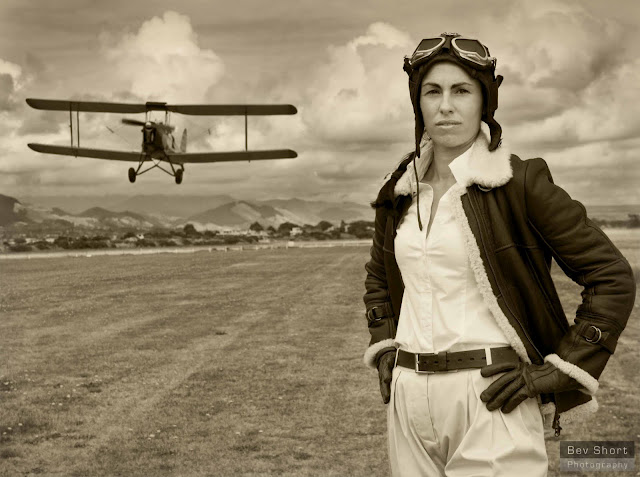
Danielle - image copyright to Bev Short. Image used with her permission.In terms of the second point is demonstrated with this image displayed here which was taken by Bev Short for her “All Women” book and exhibition.

When I first saw the image at the exhibition, my first reaction was that it was a very nice image, but I suspected that it was also a composite of two images (Danielle and the plane). In doing this I had immediately jumped to the assumption that in today’s digital age that you would not try to stage the shot.

I was surprised to hear that the shot was actually done in camera and that the photoshop treatment was pretty much limited to the sepia effect. Unfortunately I think that today our instant reaction to too many great images is that the photographer has assembled the image later. This is a real shame because in many ways it plays down on the skills of the photographer.

Now, this is not to say that there is anything wrong with composites, rather that it is just a slightly different skillset. In fact the ability to put together an image that is based on elements that you can not see together shows real creativity. Have a look at the work of either Richard Wood, Mandi Lynn or Sue Bryce and you will see that the images they produce are stunning.

On my third point that will be filled out in a later post.

Using a ND filter to control aperture.

When people think of the use of Neutral Density (ND) filters it is usually in relation with landscape photography and particularly in terms of producing milky effects in water. This is because the ND filter allows you to set a slower shutter speed that would be possible due to the amount of light causing an overexposure.

But most people would not think of using them to control the aperture that you want to shoot at so that you can produce shallow depth of field (DOF). But they can be used exactly for that purpose. And what’s more you can use the cameras light metre to work it out.

It is really simple but you do need to work in manual for the final result.

Let’s assume that you have a lens that can shoot at f2.8 and that is what you want to use to achieve a shallow DOF to blur the background. If you have a ND8 filter then this will restrict light by the equivalent of 3 f-stops. On the f-stop range the full stops are:

1    1.4    2    2.8    4    5.6    8    11    16    22

So going 3 stops from 2.8 is 8.

Therefore to shoot this, firstly set you camera in aperture priority and set it at f8. Take a photo without the filter in place and in the image information look at the shutter speed that the camera chose.

Now go into Manual mode and enter that shutter speed, and then change the aperture to f2.8 and then attach the ND filter.

Now some of you may be wondering why when I was in aperture priority I didn’t just enter f2.8 and let the camera come up with the matching shutter speed. Very good questions indeed.

If I was shooting outside I could do just that, however I may wish to still have some movement in the shot. If a setting of f8 gave me a shutter speed of 1/200, then f2.8 will give me 1/1600 which will effectively freeze everything.

If I am in the studio under flash such a shutter speed would be impossible. This is because cameras have a maximum shutter speed that can be used with the strobes. This is either 1/200 or 1/250 depending upon the make and model of the camera. If you exceed that speed what happens is you get the shutter obscuring part of the image. This value is referred to as the maximum sync speed.

And in confined spaces it is often difficult to get the power level of the lights low enough to keep below the maximum sync speed when the aperture is wide open.

When using strobes you do the calculation the other way around. Set your camera in shutter priority and take photos your subject. From the information the camera produces alter either the shutter speed or the power and/or position of the lights until you achieve f8. Then go into manual select that shutter speed, set the aperture to f2.8 and put the filter on.

Obviously the process of setting a f-stop with studio lights is a lot easier if you use a separate light meter rather than relying on your camera.

Sources of Inspiration

I have sometime been asked where I come up with the ideas for shoots. Quite often that is something that is difficult to answer as often a shoot ends up combining several different ideas that may have come from various sources.

Sometimes the inspiration comes from another image or a piece of art. The image here of Aleks is based on a painting that I saw in a gallery in Wellington. I have often found that paintings can provide inspiration particularly for poses.

Others times i will see or buy an object that I think has potential just to play with it.

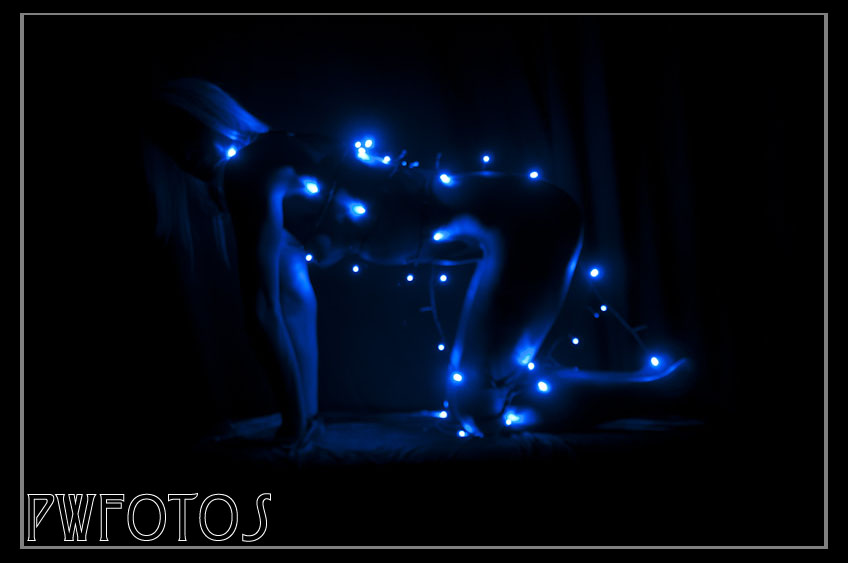
I saw a string of LED christmas lights on trademe some time ago and thought they would be quite cool to use in a shoot. Back in May I shot them as one of my “Photo a Day” images which is showed at the bottom of this page.

No this is quite nice but I thought I could make it more interesting so with a model willing to be wrapped in the lights you end up with the following image.

Herding Cats

If you shoot weddings you know that they can be quite stressful at times because there are keys shots and moments that you have to record, that basically you can ask for a re-shoot. It is almost the same at kids birthday party.

Except at weddings you generally don’t get the other wedding party deliberately trying to get at the wedding cake, nor getting in the shots (well nearly not always).

Rogue is the 4 year old son of Photographer friend and she asked me along to record his birthday. He was so eager to blow out the candles that he started even before his mother had the cake on the table. Fortunately I managed to get in at least one shot of his efforts at extinguishing them.

And if your wondering about the title of this post. Well the party was held at a cafe that had a Karate Dojo attached to it. While the theme of the kids was pirates, the session was run as a Karate birthday party complete with Kata sessions and games.

The organiser from the Dojo admitted later that they normally ran such parties for older kids as three & four olds are not the easiest to listen to instructions or stay focuses. In fact for some the games they headed off in all directions. A bit like how a bunch of cats would behalf.

Respect

This post is not about a session I have shot but rather the culmination of a number of things that I have seen or experienced in the last six months. I have titled it “Respect” because this is to be is central to how I deal with people when I am shooting them. Please bear with me as I hope this will not turn into too much of a ramble.

The first instance that sparked this post occurred back in February when I did a shoot with Maly. For at least half of the session all she had on was wearing was a length of fabric, some of which was very sheer. During a break in the shooting she asked me how it was that I could concentrate on the photography when she was dressed in so little. I explained that I was so focused on getting the shots that I was not actually looking at the fact that she had very little on. In fact I have done sessions where at the end as I have reviewed the images I have not remembered taking them. I also explained that the purpose of the shoot was to produce art and not simply to let me see her naked.

The second discussion occurred during my shoot with Aleks. We were discussing a reasonable successful photographer (in terms of awards) that we both had done shots with. Aleks did not have a very positive impression of his mainly because he wanted to shoot more erotic style images with her when all she had agreed to was a nude shoot. When she refused he ended the shoot.

Now I always tell my nude models that I am going to produce shots where shadows will play a concealing part and that they will resemble early “Playboy”, and definitely not modern day “Penthouse”. In reality the difference is posing between the two can be as little as 3 inches in terms of where the model is relative to the camera. In doing this I am respecting their right to a level of privacy. The only time I have ever done a shot where literally everything was on full display was one at the specific request of the subject.

I always tell them that if I ask them to go into a pose and they are not comfortable doing it then they can say “no” and we will try something else. I do not believe that it is right to push anyone past their own comfort zone (unless they are getting paid for it). That is the way I would like it, therefore the way I treat others.

Producing a great image, especially concept shots, actually involves a collaboration between the photographer and the model. If you as a photographer do not respect the model then the chances of producing great work just got a lot harder.

Red, Green & Blue

If you know anything about colour theory then you will know that Red, Green and Blue are the primary colours. All other colours can be created from them and if you meet them at full strength you end up as white. They are the main colours that you see on all electronic devices.

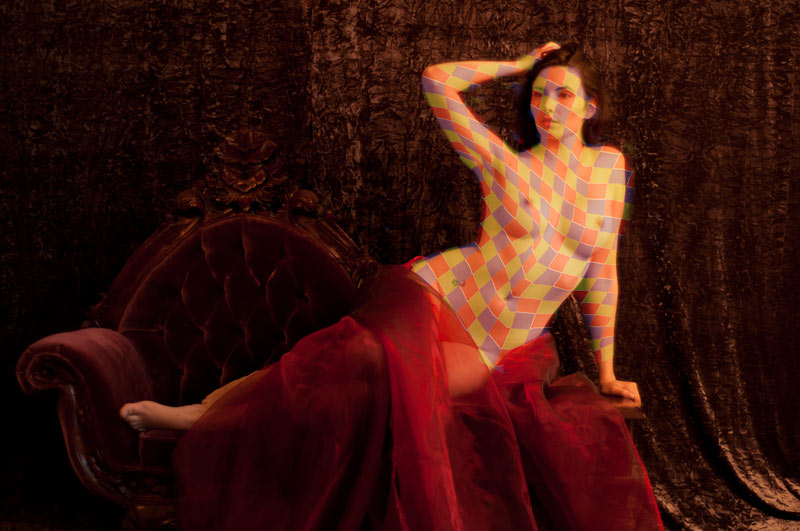
Red, Green & Blue was another of the topics in the 2012 Interclub Challenge. I decided very early on that I want to show the colours merging into white as one entry, and that I wanted to use a model. The original concept as shown in the photoshopped image was discussed with a makeup artist, and I had a model agree to do it. It never came to fruition as it was going to tie people up for too long and also be expensive.

It was then that I say an illustration that used fabric and when I showed it to Maya (my model) she loved it.

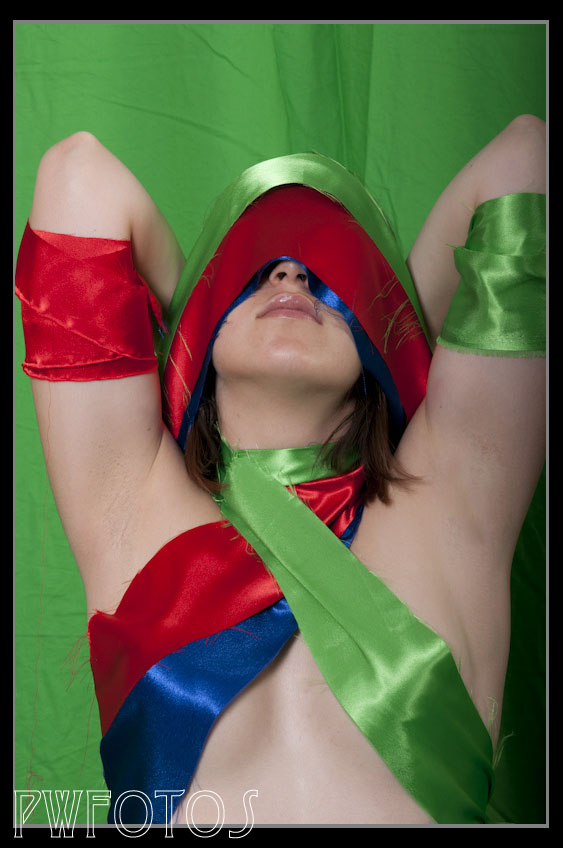
Now ribbons are also expensive but I managed to find satin material that I could cut up and then press ganged my daughter into sewing together into long ribbons. This gave me more than enough material to play with. The only draw back was that the satin freyed and so left little threads everywhere.

We decided that we were going to shoot two different concepts. The first would be similar to the illustration and we would simply deploy each of the ribbons in a light wrap. This is the shot that came about from that concept.

Then in the second series I would bring in the concept of the colours mixing into white. I had obtained a full white mask and a white wig. Maya was very accommodating because it took me and her friend Holly nearly 15 minutes to completely wrap the ribbons around her. It probably would have not been that bad for her if we had not started by putting on the mask & wig.

The final image was manipulated a little in photoshop to really make it “pop” and I hope that it has the dramatic effect I was after.

Aleks in Lingerie

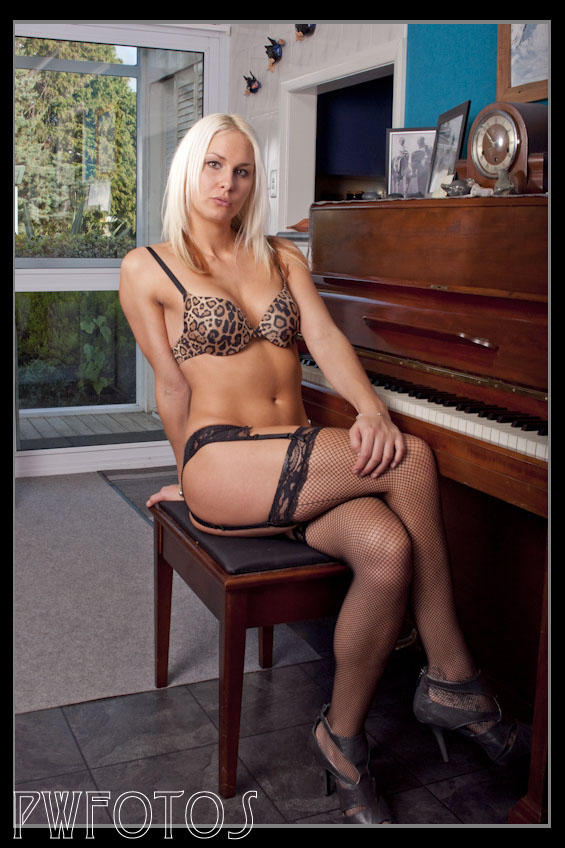
I met Aleks through the model mayhem site although it turned out that she was friends with one of the other models I had shot. After a couple of false starts we managed to set up a shoot for her portfolio. She particularly wanted to do a series of shots in lingerie. I had done plenty of this style before but mainly in a studio environment and I decided that I wanted to try something different. I wanted to set the shots in positions and poses that you would see in lingerie ads. Therefore I planned to use several rooms around the house.

There are two challenges that you face when shooting around the house, rather than in a controlled environment.

Firstly you have be very careful with what appears in the backgrounds. While I thought I had most things taken care of it is amazing how small things will suddenly appear after the shoot when you are reviewing the images. Thankfully Photoshop can fix those.

The second challenge is windows and particularly reflections of the lights in them. I solved this by mounting the camera on the tripod and took two shots in quick succession. The second one was too quick for the flash to recharge nor for Aleks to move so essentially I got a fully masked image that I could composite.

A matter of perspective

Often if you want to produce an image that is dramatically better, or just different, from the same old, all you have to do is change the perspective that it is shot from. I have learned this well over the last 18 months as I have been shooting my “photo a day” images.

At lunch time today I sat down by the Wellington War Memorial to eat. Very some I was joined by a cheeky sparrow and the couple of pigeons, all eager to share in whatever would fall their way. I decided to take an image of my lunch partners but when I looked at all I could say was “boring”.


Then I thought maybe I could put the camera on the ground and see what I could capture. The result is a much better image and my photo for 18th July 2012.

A photographic journey